

If you are still debating the hex code of a "Buy Now" button for your Tuesday newsletter, you are not operating a business. You are running an arts and crafts project. In 2026, the manual email broadcast is a legacy format. It provides vanity metrics for marketers but zero scalable growth for founders.
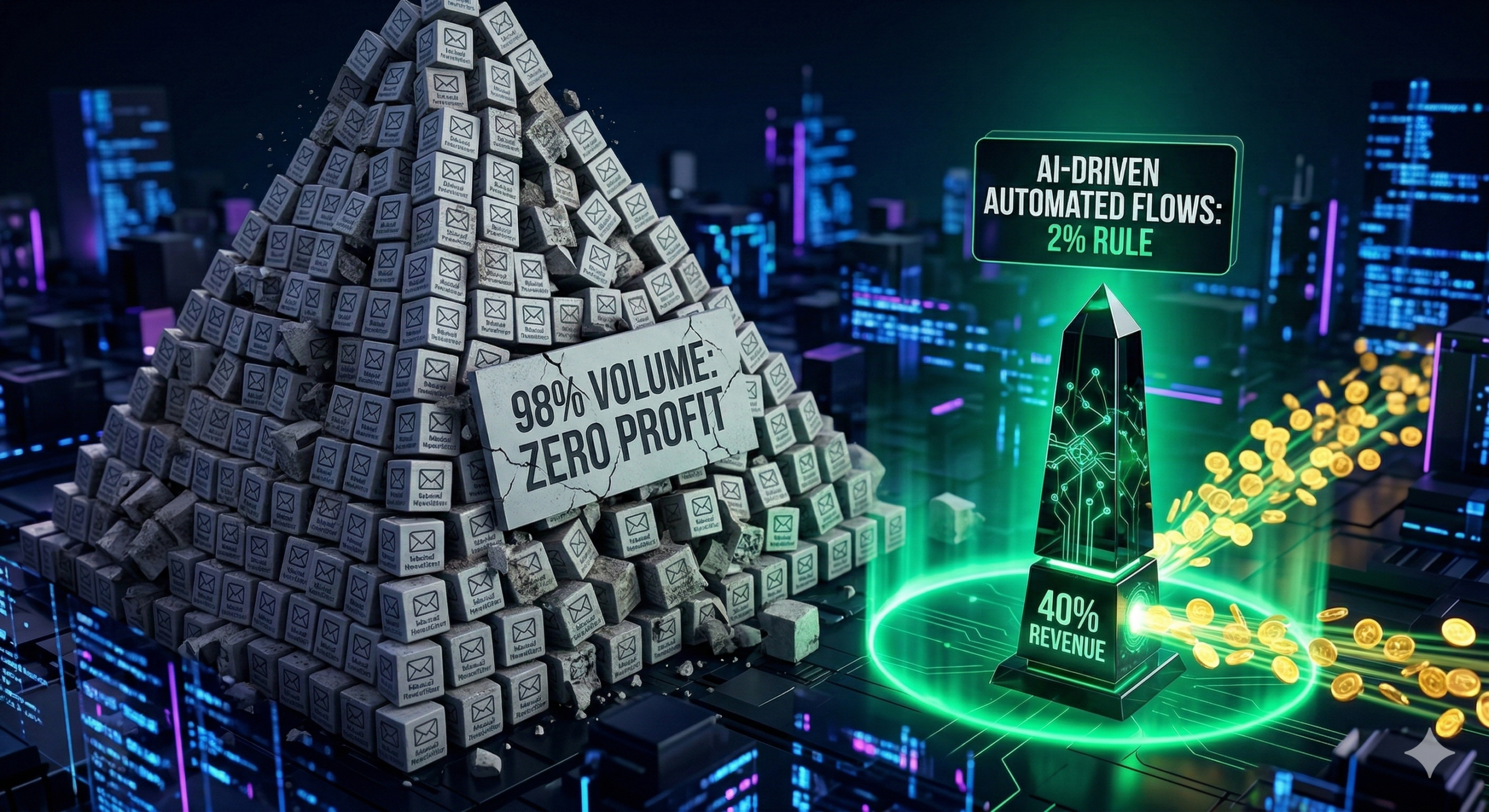
The data is unforgiving. While manual newsletters make up 98% of your sending volume, they are practically irrelevant to your bottom line. The 2% Rule is the only metric that dictates survival: automated, behavior-triggered flows—making up barely 2% of your total email volume—currently generate 40% of all e-commerce email revenue.
The math is brutal. Two percent of the infrastructure is doing almost half the heavy lifting. Here is a mechanical breakdown of why your manual strategy is bleeding cash and why AI-driven triggers are cannibalizing what is left of your newsletter revenue.
The Deliverability Tax: Content Fatigue and Dead Broadcasts
The traditional newsletter is suffering from terminal irrelevance. In an inbox governed by Apple Intelligence and aggressive Gemini spam filters, a generic "Weekly Update" is classified as noise. Consumers in 2026 do not want to hear from you when you decide to hit send; they expect a response only when they initiate an action.
Manual broadcasts have become a direct tax on your deliverability. High volume paired with low engagement—the exact definition of a newsletter blast—signals to ISPs that you are a nuisance. When you send 100,000 users the same static offer, you are not staying top of mind. You are actively training your database and the inbox algorithms, to ignore your domain.
The Cannibalization Effect: Triggers vs. Static Blasts
Automation is no longer a supplementary revenue stream. It is actively cannibalizing your manual campaigns. The gap between a static broadcast and a real-time behavioral trigger is unbridgeable.
Manual Newsletters: Static, delayed, and based entirely on the sender's schedule.
AI-Driven Flows: Dynamic, instantaneous, and strictly governed by user intent.
When a user abandons a specific product category and receives a tailored summary of those exact items three minutes later, the conversion rate is historically 12x higher than a generic promotional blast. The trigger eats the newsletter's revenue because it strikes at the exact peak of consumer intent. If you rely on scheduled broadcasts, you are leaving your most motivated buyers to be captured by competitors running real-time infrastructure.
Real-Time Adaptation: The AI Trigger Advantage
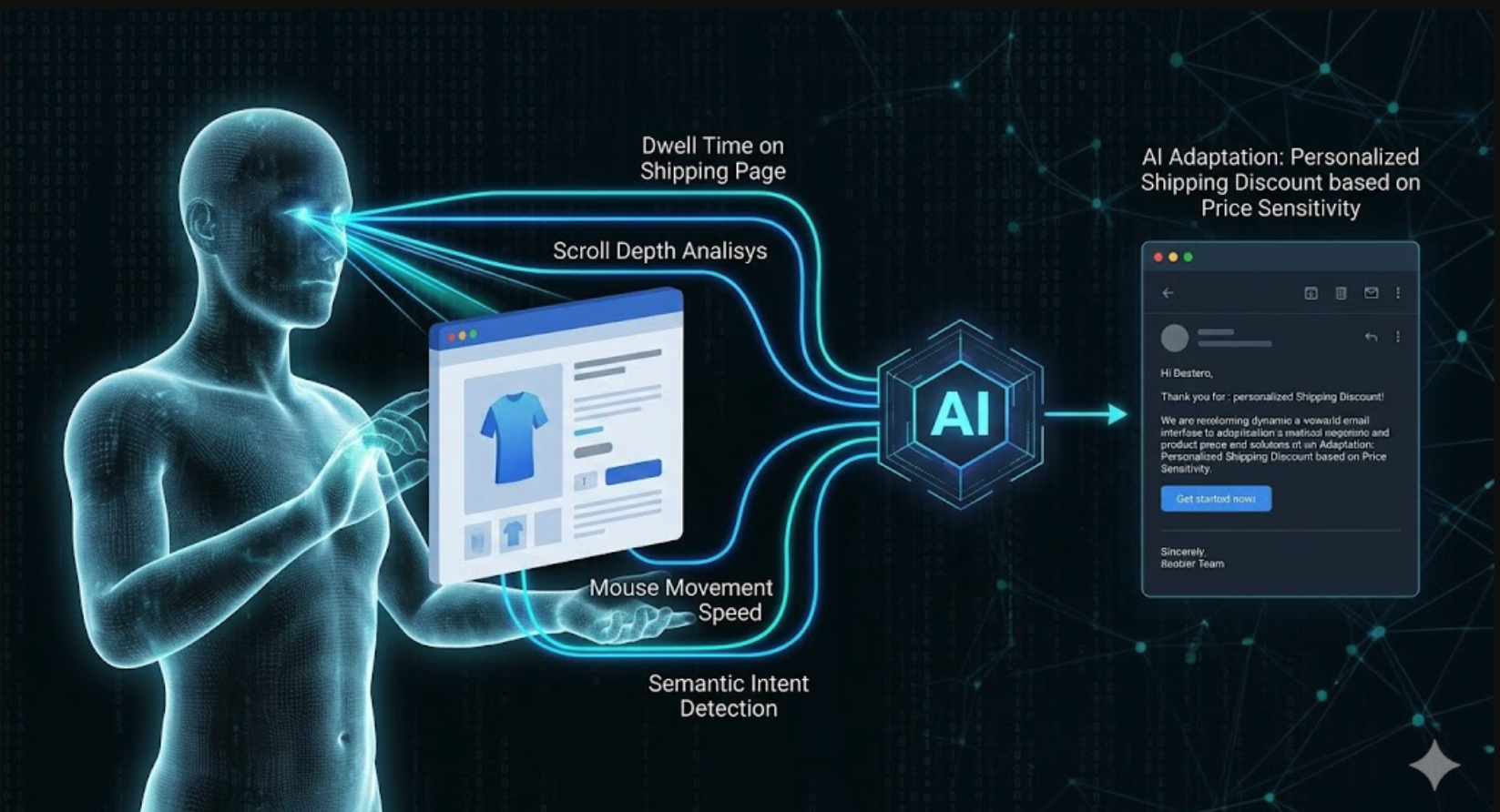
In 2026, the definition of an "Automated Flow" has evolved. We are no longer talking about basic "If This, Then That" logic. Modern triggers are predictive and highly contextual. They do not just track a click; they analyze dwell time, scroll depth, and on-site mouse movement to reconstruct the offer in real-time.
1. Contextual Pricing & Relevancy: If a user looks at a $500 item but bounces at the shipping calculation, the AI does not send a generic "You forgot this" reminder. It calculates a personalized shipping margin or surfaces a $400 alternative based on their historical price sensitivity.
2. Aggressive Frequency Capping: AI prevents automation overlap. It detects if a user is simultaneously in a welcome sequence and a browse abandonment flow. It suppresses the lower-converting message instantly to protect your Sender Score.
3. Semantic Auto-Correction: Modern flows rewrite their own copy to match the specific behavioral cohort of the user, pulling raw factual data directly from your site's HTML to bypass spam filters.
The Final Verdict: Stop Designing, Start Architecting
You can keep A/B testing your newsletter subject lines until you run out of budget, but the 2% Rule will remain absolute. Every hour spent designing a manual broadcast is an hour not spent refining the logic of your automated revenue engine.
In 2026, a CMO is a systems architect, not a creative director. If your automated flows are not generating a minimum of 35% of your total email revenue, your entire marketing infrastructure is broken.
Stop talking at your audience. Build the systems that respond to them.
📚 References & Technical Sources
Omnisend Insights: Automation vs. Manual Campaigns: 2026 Deliverability Data
Mantas Digital: The State of E-commerce Triggers and Revenue Attribution
E.Gerion Reviews: PCI DSS v4.0 & DMARC: How Broken DNS Freezes Payments in 2026
E.Gerion Reviews: Goodbye, Preheader: Why AI Email Summaries Are Rewriting the Rules