

Most brands still treat email authentication like plumbing. Something technical. Something boring. Something for “later.” But the reality of email authentication 2026 is brutal. That is why so many teams are staring at soft engagement, collapsing inbox placement, and fake optimism in dashboards that should have been buried with 2023.
Here is the part nobody likes to say out loud: if your domain is missing proper SPF, DKIM, and DMARC, you are not doing email marketing. You are doing digital littering with extra steps.
Google, Yahoo, Apple-driven filtering layers, and AI-assisted inbox systems do not care about your internal excuses. They do not care that your CRM “usually works.” They do not care that your designer spent six hours adjusting button padding. In 2026, technical trust is the first filter. Content quality comes after. If your authentication is broken, the message is judged as suspicious before your copy even gets a chance to fail on its own.
This is the mechanical breakdown of why email authentication is now the baseline cost of entry, why weak setups are getting buried, and what needs to be fixed immediately.
Why It’s Broken
The old model was simple: write a subject line, send enough volume, watch opens, pretend results were stable. That model is dead.
In 2026, inbox providers evaluate two layers before they reward reach:
- Identity trust — can your domain prove the message is legitimate?
- Behavioral trust — do recipients engage like this mail deserves to exist?
Most weak programs fail at the first layer.
For years, marketers treated authentication like a box-checking exercise:
SPFadded once and forgottenDKIMenabled on one platform but missing on anotherDMARCleft atp=noneforever, which is the DNS equivalent of installing a lock and never turning the key
That lazy setup used to limp along because mailbox providers tolerated sloppiness. That tolerance is gone. Large senders are now judged on authentication consistency, not good intentions. And AI filters are ruthless with mismatched headers, unsigned mail, spoof-friendly domains, and contradictory sending patterns.
If multiple systems send on behalf of your brand—newsletter tool, CRM, WooCommerce plugin, support desk, WordPress forms, transactional SMTP—you are running a trust chain. One weak link contaminates the whole domain.
That is why “some emails still arrive” is a useless defense. A partially authenticated stack is not healthy. It is unstable. It means one segment lands in inboxes, another bleeds into spam, and a third gets throttled quietly while your team argues about copy tone.
The 2026 Reality: Inboxes Are Now Identity Filters First
Authentication is no longer a deliverability enhancement. It is the admission ticket.
Major providers tightened sender requirements because phishing, domain spoofing, and AI-generated scam volume exploded. The response was predictable: stricter enforcement of domain trust.
Today, if your message fails alignment or comes from an untrusted path, inbox systems do not “give it a chance.” They suppress, redirect, bulk-folder, or reject. Quietly. Efficiently. Without caring about your campaign calendar.
What Each Standard Actually Does
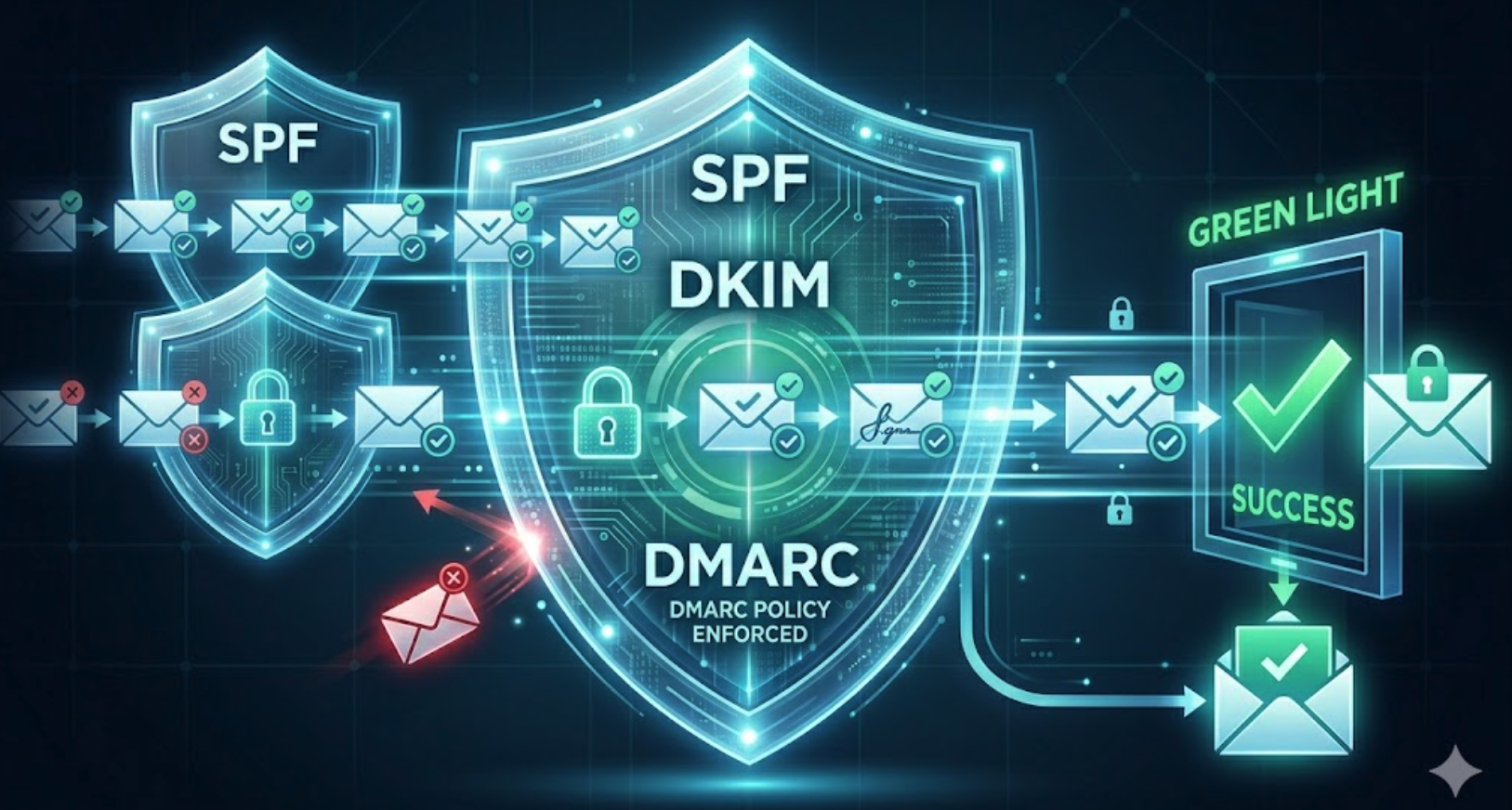
SPF tells receiving servers which IPs or services are allowed to send mail for your domain.
DKIM adds a cryptographic signature proving the message content was authorized and not altered in transit.
DMARC ties identity together by enforcing alignment and telling receivers what to do when a message fails authentication.
In plain English:
SPFsays who may sendDKIMsays the message is signedDMARCsays what to trust and what to kill
If one of these is missing, weak, or misaligned, your domain starts looking like a counterfeit brand asset. In 2026, that is enough to lose inbox trust.
The p=none Delusion: Why Monitoring Alone Is a Joke
Let’s kill one of the industry’s favorite bad habits.
Thousands of businesses still brag that they “have DMARC enabled” when their record is sitting at:
v=DMARC1; p=none;
That is not enforcement. That is observation. You are watching abuse happen and politely requesting that receivers do nothing about it.
In 2026, a domain parked on p=none for months is broadcasting one message: we know our perimeter is loose and we have chosen not to fix it.
That affects more than spoofing risk. It affects sender credibility. Providers increasingly interpret enforcement maturity as a proxy for operational seriousness. If your domain still has no quarantine or reject policy, you look like an easy impersonation target. Because you are.
What Happens Next
- Spoofed messages hit users under your brand
- Complaint signals rise
- Provider trust drops at the domain level
- Legitimate campaigns inherit the damage
- Marketing blames creative, timing, or “market fatigue”
No. The market is not the problem. Your DNS hygiene is.
The Mechanical Breakdown: How Broken Authentication Kills Revenue

This is where most teams get exposed. They think deliverability failure looks dramatic. Sometimes it does not. More often, it looks like a slow commercial suffocation.
1. Shared Domain Confusion Destroys Alignment
A company sends from:
- a marketing platform
- a sales CRM
- a WordPress form plugin
- an ecommerce engine
- a support platform
Each system uses slightly different headers, bounce paths, and signing domains. One signs with aligned DKIM. Another only passes SPF. A third routes through infrastructure never added to SPF at all.
The result is fragmented identity. Receivers do not see “one trusted sender.” They see a messy cluster of inconsistent technical claims. That inconsistency is a spam signal.
2. AI Filters Penalize Weak Trust Before Engagement Happens
Modern inbox systems do not wait for large complaint volumes. They model risk early.
If your sender identity looks unstable, the system can:
- bulk-folder the campaign immediately
- throttle delivery across segments
- withhold placement until engagement proves legitimacy
- favor authenticated competitors in the same promotional category
This matters because weak placement starves you of engagement, and weak engagement then “confirms” the low-trust assessment. That is a feedback loop. A stupid one. And expensive.
3. Manual Broadcasts Magnify Authentication Weakness
Here is the ugly math founders should understand.
Manual campaigns still make up the majority of send volume in many businesses. But when those broadcasts leave a poorly authenticated domain, they create the worst possible signal mix:
- high volume
- generic content
- uneven engagement
- increased complaint probability
- zero technical grace from providers
That is why old batch-and-blast tactics now function like a deliverability tax. You are paying for reach while training inbox algorithms to distrust you.
4. Authentication Failure Corrupts Your Data Layer
Bad inbox placement does not just reduce opens. It poisons strategic decision-making.
If messages are being throttled or spam-foldered because of technical trust issues, then:
- your open data becomes distorted
- your click comparisons become unreliable
- your segment scoring becomes weaker
- your AI optimization models train on compromised outcomes
This is where 2026 gets brutal. Teams are now using AI to predict send times, optimize segments, and adjust campaigns in real time. But if the underlying delivery layer is broken, the AI is learning from garbage. That is not advanced marketing. That is automated stupidity.
The Revenue Logic: Why Authentication Now Sits Upstream of Performance
Email operators still obsess over downstream metrics:
- open rate
- click rate
- read time
- conversion rate
Fine. But all of that sits downstream of one prior event: did the mailbox provider trust your message enough to place it where a human might actually see it?
That is why authentication now controls revenue indirectly but decisively.
If your infrastructure fails trust checks:
- less mail reaches the inbox
- fewer users interact
- behavioral signals weaken
- future campaigns inherit lower trust
- automation performance deteriorates
And then the usual circus begins.
The brand redesigns templates. The copywriter is blamed. Someone suggests “more emojis.” A consultant runs another subject line test. This is not optimization. This is watching adults decorate a machine with a broken engine.
Why AI-Powered Marketing Makes Authentication Even More Critical
The market has shifted toward AI-powered automation, predictive segmentation, and self-optimizing workflows. Platforms like Klaviyo and similar orchestration tools are pushing a model where campaigns are adjusted continuously based on behavioral data across email, SMS, mobile push, and other channels.
That sounds impressive. It is. But it creates a harsher requirement:
if your identity layer is unstable, the entire automation stack performs below its theoretical value.
AI can optimize timing. It can personalize offers. It can rewrite subject lines. It can predict churn. None of that rescues a domain that looks spoofable, inconsistent, or technically negligent.
In fact, smarter systems make weak infrastructure easier to expose. Because once orchestration scales, every authentication flaw is repeated faster and across more journeys.
The Self-Optimizing Trap
Marketers love the idea of self-optimizing systems. Few understand the risk.
If your system is learning from campaigns with degraded inbox placement, it may start making false conclusions like:
- this segment is low intent
- this product category underperforms
- this send time is weak
- this creative format is ineffective
Wrong. The campaign may have been invisible because the domain failed trust thresholds.
So before you worship AI orchestration, fix the authentication foundation it depends on.
The Trust Shift: Why Privacy-First Marketing and Authentication Now Converge
The market is also moving toward transparency, better consent practices, and privacy-first data collection. Good. It needed to.
Users are more willing to share data with brands they trust. Providers are more willing to deliver mail from domains that act like adults. These are not separate trends. They are the same trust economy expressed in different layers.
A brand that:
- asks for consent clearly
- sends relevant email
- uses data transparently
- authenticates its domain properly
creates coherent trust signals.
A brand that:
- scrapes attention with generic blasts
- uses vague data practices
- fails authentication
- lets spoofing remain possible
creates coherent distrust signals.
The industry still tries to separate “privacy,” “deliverability,” and “personalization” into different conversations. That is convenient and wrong. In 2026, they are all parts of the same operating system: trust.
The Fix: What You Need to Do Right Now
This is not complicated. It is just neglected.
1. Audit Every Sender Touching Your Domain
List every system that sends mail as your brand:
- ESP
- CRM
- WordPress plugins
- WooCommerce notifications
- support desk tools
- billing platforms
- cold outreach tools if someone in sales is being reckless
If it sends email, it belongs in the audit.
2. Lock Down SPF
Make sure your SPF record includes only authorized senders and does not exceed lookup limits.
- Remove dead vendors
- Flatten where necessary (SPF flattening helps stay under the 10-lookup limit)
- Check that envelope paths align with actual sending sources
A bloated or outdated SPF record is common and embarrassing.
3. Upgrade and Align DKIM
Enable DKIM on every legitimate sender and move to 2048-bit keys where supported.
- Use consistent domain alignment
- Verify selectors are active
- Test across all mail streams, not just newsletters
If your marketing mail is signed but your transactional mail is not, you are still leaking trust.
4. Move DMARC Toward Enforcement
Start with monitoring if you must, but do not live there forever.
p=noneis temporaryp=quarantineis progressp=rejectis where serious operators end up
Review aggregate reports, identify legitimate failures, fix alignment, then escalate.
5. Clean Your Sending Architecture
Do not let random plugins and forgotten vendors send under your main domain. Separate streams where appropriate. Align visible From domains with signed identities. Reduce unnecessary complexity.
Deliverability problems often look mysterious only because teams built a Frankenstack and stopped documenting it.
6. Stop Treating Authentication Like IT Housekeeping
This is a revenue system issue, not a side quest for your developer.
Authentication affects:
- inbox placement
- brand protection
- data quality
- AI optimization accuracy
- campaign efficiency
- customer trust
That is marketing infrastructure. Own it accordingly.
The Anti-Trend: What Fails in 2026
If you want the short blacklist, here it is.
- Mass untargeted blasts with weak engagement
- Authentication left half-configured
DMARCparked atp=nonefor eternity- Opaque data practices that make users distrust the brand
- Fake personalization that is really just segmentation theater
- AI-written filler sent from technically untrusted domains
That combination is not a strategy. It is how brands train mailbox providers to ignore them.
The Verdict

In 2026, SPF, DKIM and DMARC do not support email marketing. They decide whether you get to do it at all.
If your authentication stack is weak, your campaigns are being filtered through distrust before subscribers ever make a choice. That means worse inbox placement, weaker data, lower automation performance, and a slower revenue engine.
Fix the identity layer. Enforce DMARC. Align every sender. Stop shipping campaigns from a domain that looks like it was assembled during a school workshop.
Because when the infrastructure is broken, the copy is irrelevant.
References & Technical Sources
-
Google sender requirements for bulk email:
https://support.google.com/a/answer/81126 -
Yahoo sender best practices for authenticated mail:
https://senders.yahooinc.com/best-practices/ -
DMARC.org guidance on enforcement and alignment:
https://dmarc.org/overview/ -
Industry platform documentation (HubSpot 2026 Trends):
https://www.hubspot.com/state-of-marketing - E.Gerion Reviews: From Gmail Red Flags to SMTP 550 Errors (2026):
https://egerionreviews.com/gmail-red-flag-smtp-550-error-2026