

A week has passed since the first mass reports on Apple Intelligence deployment — and the data confirms it: those who haven’t restructured their opening paragraph are already losing up to 20–30% of potential opens to irrelevant AI summaries.
The Death of the Classic Subject Line
You spent two weeks A/B testing subject lines. Forty-three variations. Statistical significance reached. Winner declared. You schedule the send feeling like you’ve done the work.
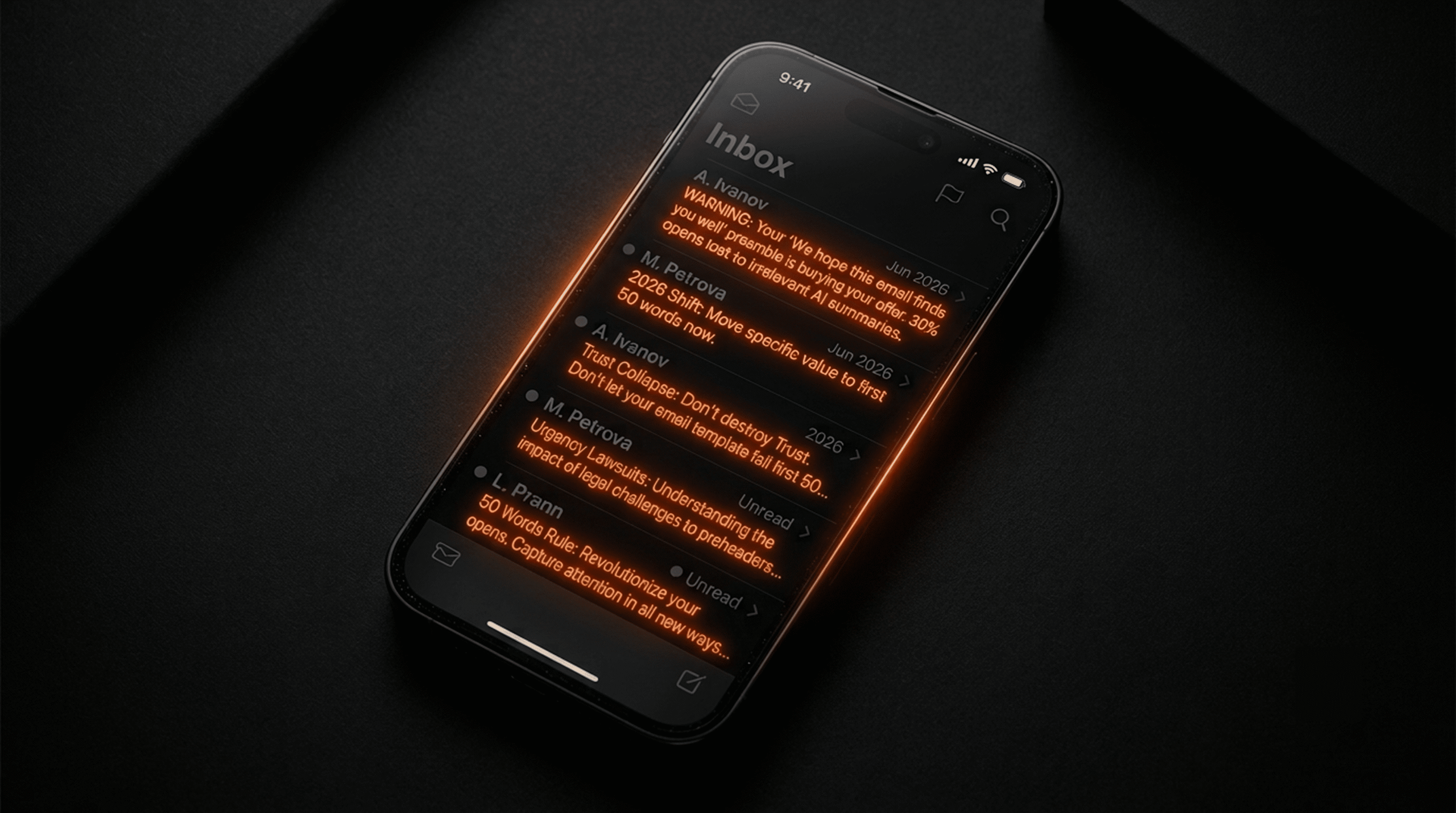
Meanwhile, a significant portion of your Apple Mail subscribers never see that subject line at all. They see ten words that Apple Intelligence generated from your email body — and those ten words came from your opening sentence: “Hi Sarah, we hope this email finds you well.”
That’s your subject line now. You didn’t write it. You didn’t test it. An algorithm assembled it from the least interesting sentence in your email.
This is the new reality of Apple AI email marketing in 2026 — and most email teams are still optimizing for a user experience that no longer exists.
Section 1. How the New Trust Algorithm Actually Works
The technical reality
Apple’s 2026 OS updates replaced the traditional preheader snippet with AI-generated summaries in the Promotions and Updates tabs. The system generates approximately 10 words from the body of your email — not from your subject line, not from your preheader, but from the actual opening content of the message.
The AI doesn’t know what you consider important. It reads what comes first. If your email opens with a generic greeting, a disclaimer, an unsubscribe notice, or a legal footer pushed to the top — that’s what gets surfaced. Your carefully crafted offer, the one buried in paragraph three, stays buried.
This matters for inbox placement 2026 in a direct way: Apple Mail accounts for a significant share of email opens globally. When your message is misrepresented by an AI summary that fails to communicate value, the subscriber doesn’t open. Low open rates feed negative engagement signals. Negative engagement signals suppress future delivery. The damage compounds silently — and your analytics dashboard will attribute it to “audience fatigue” or “poor subject line performance,” because neither metric tracks what Apple Intelligence did with your opening sentence.
The damage compounds silently — and your analytics dashboard will attribute it to “audience fatigue” or “poor subject line performance,” because neither metric tracks what Apple Intelligence did with your opening sentence.
➔ Note: If you want to see the broader industry context, weekly deliverability benchmark data, and how these algorithmic updates fit into the larger email ecosystem for June 2026, check out our latest comprehensive tracking report: [E.Gerion Reviews: The Weekly Download — June 2026]
The psychology of trust collapse
Here is a number that should make every email team uncomfortable: 53% of consumers have received a legitimate email from a brand that they initially mistook for a phishing attempt — because it looked generic, impersonal, or template-driven.
Think about what that means operationally. More than half your subscribers have, at some point, looked at a legitimate email from a real brand and thought: this looks like fraud. In that moment, they either delete it, mark it as spam, or ignore it permanently. None of those outcomes is recoverable with a better subject line next time.
The brands that win in this environment are the ones that make trust visible — immediately, in the first sentence, before the subscriber has made any decision about engagement. An AI summary that opens with a specific, valuable, human-sounding sentence signals safety. A generic greeting signals nothing — or worse, signals automation without intent.
Section 2.Apple AI Email Marketing: Why 50 Words is Your New Subject Line.
Why 50 words is your new subject line
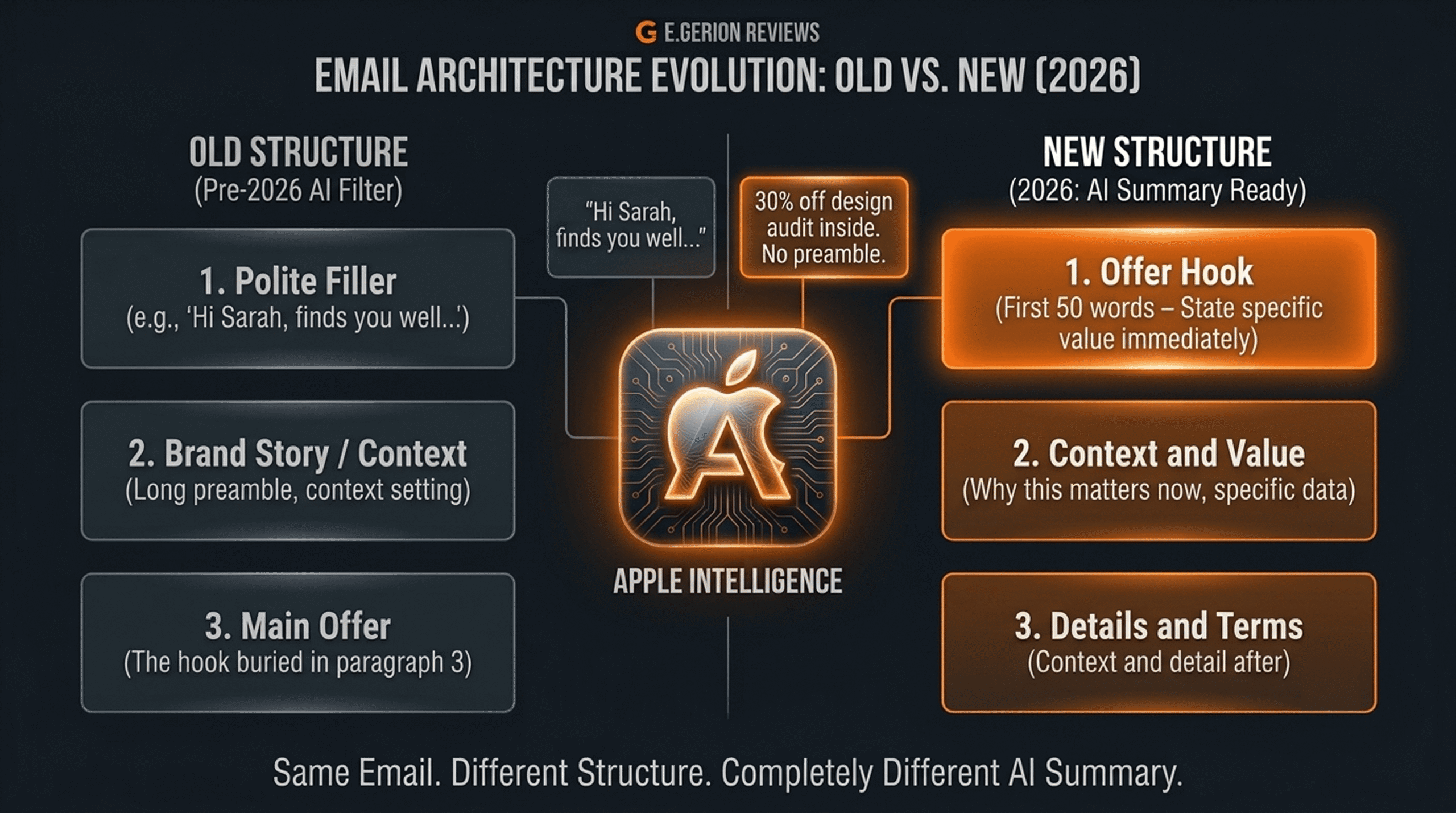
The practical implication of Apple’s AI summary is that your offer hook must live in the first 50 words of your email body. Not in the subject line. Not in the preheader. In the opening sentences of the actual content.
This is a structural change, not a stylistic one. It requires rewriting how emails are built from the ground up.
What the first 50 words need to accomplish in 2026:
— State specifically what this email is about
— Communicate the primary value or offer without preamble
— Sound like a human wrote it for a specific person, not a template engine
That’s it. No warming up. No context-setting. No brand storytelling before the point.
The anti-patterns that are killing your open rates right now
“Hi [First Name], we hope this email finds you well.”
This sentence is the single most damaging opening in email marketing in 2026. It communicates zero value, it sounds robotic despite using personalization syntax, and it’s exactly what Apple Intelligence will surface as your email summary. It is the worst possible trade for the most valuable real estate in your send.
Other anti-patterns actively working against you:
“As a valued customer…” — signals mass send, not personal communication.
“We’re excited to share…” — the brand’s excitement is irrelevant to the subscriber’s decision to open.
“In today’s fast-paced world…” — a tell for AI-generated filler that sophisticated readers filter immediately.
“Please find attached / linked below…” — bureaucratic language that positions your email as administrative overhead, not a conversation.
Every one of these openings hands Apple’s AI summary algorithm a useless sentence to represent your entire message.
The 80/20 editorial rule and why AI summary reflects it back at you
The 80/20 principle in email — roughly 80% value-driven content, 20% direct sales — isn’t new. What’s new is that AI summary makes your content ratio visible before the subscriber even opens.
An email that opens with a direct pitch reads like a pitch in AI summary form. An email that opens with a specific insight, a useful data point, or a concrete observation reads like content — even if it leads to a commercial offer two paragraphs later.
The editorial balance isn’t just good practice anymore. It’s what determines whether Apple Intelligence represents your email as something worth opening or something that can wait.
Section 3. The Legal Dimension: Urgency Claims Under Legal Scrutiny
While AI summaries are changing the technical landscape, a parallel legal pressure is building that makes aggressive subject line tactics increasingly risky in the US market.
A growing wave of lawsuits — concentrated in Washington and California — is targeting brands for urgency claims and discount statements in email subject lines. Plaintiffs argue that phrases like “Last chance — 70% off ends tonight” violate state anti-spam statutes when the urgency is manufactured rather than real. The legal exposure is significant: statutory damages, private rights of action, and class action risk in states with strong consumer protection frameworks— specifically Washington’s Commercial Electronic Mail Act (CEMA) and California’s Business & Professions Code § 17529.5.
The pattern of claims follows a consistent logic: if a “limited time offer” recurs every week, it isn’t limited. If a “final notice” arrives monthly, it isn’t final. Courts and regulators are increasingly treating these as deceptive practices rather than standard marketing copy.
The practical implication is not to avoid urgency — it’s to make urgency real. A genuine sale with a genuine end date creates genuine urgency. A manufactured countdown that resets every 72 hours creates legal exposure and erodes subscriber trust simultaneously. And in a world where Apple AI now summarizes your email before a human reads it, manufactured urgency doesn’t just risk a lawsuit — it creates a summary that reads like spam.
Section 4. The Adaptation Checklist
These are structural changes, not copy tweaks. Implement them before the next send cycle, not after.
Step 1: Eliminate filler from your first paragraph entirely.
Open with the specific thing this email delivers. If it’s a discount, name the discount and the product in sentence one. If it’s information, state the specific information immediately. If you can’t identify what the first sentence should be — the email doesn’t have a clear purpose yet. That’s the real problem to solve, before any optimization conversation starts.
Step 2: Move your primary offer to the first two lines.
Not the second paragraph. Not after the brand story. The first two lines. Treat the email body like a news article: the most important information first, context and detail after. This is the structural opposite of how most marketing emails are currently built.
Step 3: Read your opening sentence as if it’s the only sentence the subscriber will see.
Because for a meaningful percentage of your Apple Mail subscribers, it is. Does that sentence communicate value? Does it give a specific reason to open the full email? Does it sound like something a real person wrote to another real person? If not, rewrite it before anything else.
Step 4: Build for visible trust, not algorithmic manipulation.
The instinct to “beat” AI filters by reverse-engineering summary generation is a short-term tactic that degrades email quality and subscriber trust simultaneously. The durable approach is writing emails that genuinely deserve the attention they’re requesting — emails where the AI summary is accurate because the content itself is specific, valuable, and honest about what it’s offering.
Brands that build email programs around this principle don’t need to outmaneuver Apple Intelligence. Their emails summarize well because they’re well-written.

Verdict
Subject line optimization as the primary email performance lever is over — at least for the segment of your list reading on Apple devices, which is likely larger than you think.
The new primary lever is the quality and specificity of your opening content. What you write in the first 50 words of your email body now determines whether Apple Intelligence represents your message accurately or buries it under a generic AI-assembled sentence that no subscriber asked for.
This isn’t a technical adjustment. It’s a copywriting paradigm shift. The teams that rebuild their email architecture around the first 50 words principle — and stop treating subject lines as the only variable worth testing — will occupy the inbox positions that everyone else is quietly losing to AI intermediation.
The emails that survive this shift are the ones that deserved to survive: specific, useful, honest, and written as if a real person’s time is worth respecting.
Sources
- Ignite Visibility: Digital Marketing News — Apple AI Email Summaries, June 8, 2026 — ignitevisibility.com/digital-marketing-news/
- Mean CEO: Email Marketing Trends June 2026 — blog.mean.ceo/email-marketing-trends-june-2026/
- Mailjet: Email Marketing Trends 2026 — mailjet.com/blog/email-best-practices/email-marketing-trends-2026/
- National Law Review: Retailers Alert — New Wave of Email Marketing Lawsuits — natlawreview.com/article/retailers-alert-new-wave-email-marketing-lawsuits
- MoEngage: Average Email Open Rate 2026 — moengage.com/blog/average-email-open-rate/
- Prospeo: Standard Email Open Rate 2026 — prospeo.io/s/standard-email-open-rate
- Klaviyo 2026 Omnichannel Benchmark Report — klaviyo.com
- Digital Applied: Email Deliverability 2026 — digitalapplied.com/blog/marketing-email-deliverability-2026-inbox-placement-playbook