


Let me be direct with you. f your email marketing strategy 2026 still revolves around the monthly newsletter blast — the one your team spends three days designing, agonizing over subject lines, and then watches die quietly in the Promotions tab — you don’t have an email marketing problem. You have a strategic reality problem.
The inbox has been a minefield for years. What changed in 2026 is that the mines got smarter. Gmail’s Gemini mediates what your subscriber sees before they make any decision. Apple Intelligence generates a ten-word summary of your email body and uses that instead of your subject line. Outlook’s SmartScreen rejects non-compliant mail outright with a 550 error code before it reaches any human filtering layer.
Gmail’s Gemini mediates what your subscriber sees before they make any decision. Apple Intelligence generates a ten-word summary of your email body and uses that instead of your subject line. Outlook’s SmartScreen rejects non-compliant mail outright with a 550 error code before it reaches any human filtering layer.
➔ Deep Dive: If you want to understand exactly how Apple Intelligence is reshaping subscriber behavior and why your traditional subject line strategy is completely dead, read our separate comprehensive technical teardown here: [The Apple AI Shift: Why Your Subject Line Strategy Is Dead in 2026]
Seven years in these trenches have taught me one thing with absolute consistency: the marketers who treat email as a broadcast medium lose, slowly and quietly, until they can’t figure out why their numbers are collapsing. The marketers who treat email as infrastructure — behavioral, authenticated, earned — keep compounding.
Here’s where we stand right now.
1.Tools: WordPress 7.0 and the MailPoet Pressure Test
What happened: WordPress 7.0 shipped with Gutenberg 23.3, and the media editor finally became a real tool. Crop, rotate, metadata editing — all native, all without leaving the dashboard. For content teams running editorial operations inside WordPress, this eliminates a genuinely annoying workflow friction point that’s been there since the block editor launched. MailPoet holds at version 5.27.0 with no new release this week, but active support threads on WordPress.org are flagging compatibility tension with WP 7.0 — specifically post notification “run over” behavior and API key errors that appeared in the last 72 hours.
Analyst’s Take: The Gutenberg 23.3 media editor matters more than it looks. Every step removed from the content production workflow compounds across a team over time. Fewer context switches means faster execution means more testing cycles. That’s the real benefit — not the features themselves, but the reduction in friction that makes consistent publishing operationally viable.
On MailPoet: the WP 7.0 compatibility issues are early-stage and likely fixable in a point release, but if you’re running a production WooCommerce store with automated email flows, do not upgrade to WordPress 7.0 this week. Wait for 5.27.1 or a confirmed compatibility notice from the MailPoet team. The detail almost everyone misses in these compatibility cycles: automated flows don’t break loudly. They fail silently. Your dashboard shows “sent” while recipients get nothing. By the time you notice the drop in revenue attribution, you’ve lost days of triggered email performance with no clean way to recover the missed sends.
2.Tech Standards: The Salesforce Deadline Nobody Is Taking Seriously Enough
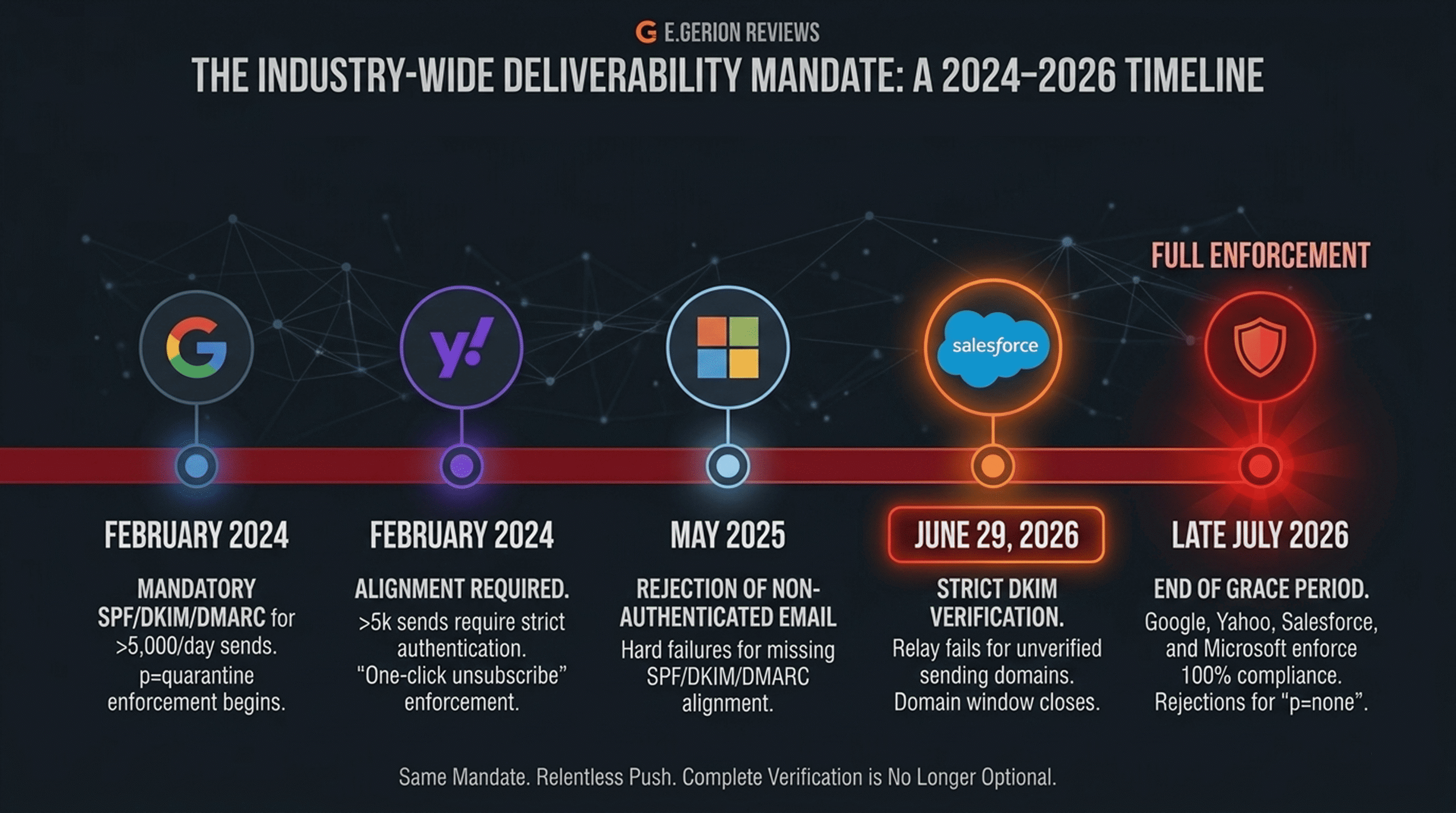
What happened: If you’re routing email through Salesforce as a relay, you have until June 29, 2026 — one week — to verify your sending domains with active DKIM keys. Miss this deadline and your relay stops functioning. Not degrades. Stops. Salesforce has been clear that unverified domains will lose relay access in late July, but the verification window closes June 29. The broader context: Google, Yahoo, Microsoft, and La Poste have all enforced SPF + DKIM + DMARC requirements throughout 2025–2026. Non-compliant mail gets a hard 550 5.7.515 rejection, not a soft temp-fail. The grace period across the industry is structurally over.
Analyst’s Take: The Salesforce deadline is the one that will catch people off guard precisely because Salesforce is used heavily for transactional and CRM-triggered email, not just marketing campaigns. When a marketing team’s newsletter platform gets blocked, someone notices. When a Salesforce-relayed order confirmation or password reset stops firing, it falls into a gap between the marketing team and the IT team, and it can sit broken for days before anyone connects the outage to the domain verification failure.
The technical detail almost everyone misses with DMARC: sitting at p=none is not a safe middle ground. It means you’re monitoring without protecting. An attacker can spoof your domain, send phishing emails that appear to come from you, and your p=none policy instructs receiving servers to do exactly nothing about it. Your brand reputation takes the hit from attacks you had the tools to prevent. The path to p=reject takes 90 to 120 days done responsibly — monitoring at p=none, then graduating to p=quarantine with pct=10, ramping over four to six weeks, then full enforcement. If you haven’t started, the June 29 deadline is a forcing function to begin today, not to just clear the Salesforce checkbox and move on.
3.AI in Marketing: The Platform Tier Is Finally Delivering
What happened: The AI email marketing landscape has sorted itself into three functional tiers. Platform AI — Mailchimp, HubSpot, ActiveCampaign, Klaviyo, Brevo, Omnisend — is now genuinely useful because it operates on your actual account data. HubSpot’s Breeze suite specifically pulls contextual signals from the CRM: deal stage, lifecycle position, last activity, engagement velocity. It’s using the data you already have to inform when to send, what to say, and which contacts to suppress. Specialist AI tools like Jasper and Lavender excel at single dimensions. Agent AI like Sai runs fuller workflow cycles with human approval gates before sending.
Analyst’s Take: The distinction that separates useful AI from expensive decoration is whether the tool learns from your data or generates from generic training. An AI subject line tool that optimizes based on your historical send performance, your specific audience’s engagement patterns, and your product catalog is a force multiplier. An AI subject line tool that generates from broad internet training data and calls it personalization is a faster way to produce generic copy at scale — which is precisely the category of content that is getting hammered by spam filters in 2026.
HubSpot Breeze’s CRM-native approach matters because it solves the data isolation problem that makes most AI implementations underperform. When your email platform doesn’t know what your sales team knows about a contact — their deal stage, their last call, their stated objections — AI personalization is guessing. When Breeze can see the full CRM context, the personalization is grounded in actual signal. The detail most teams miss: AI send-time optimization only works if you have sufficient historical engagement data per contact. Beneath roughly 8–10 prior sends to a given subscriber, there’s not enough behavioral history to optimize against. For new subscribers, use send-time optimization at the segment level, not the individual level, until the data accumulates.
4.Anti-Trends: How Manufactured Intimacy Ruins Your Email Marketing Strategy 2026
What happened: The dominant failure mode in email marketing right now is AI-generated fake personalization — emails that use first names, purchase history references, and behavioral triggers to simulate a relationship that doesn’t exist. EmailTooltester’s June 18 update confirmed that spam now accounts for 51.8% of global email traffic, reversing eight years of decline. Barracuda’s data shows AI tools are generating the majority of detected spam. The operational consequence: inbox providers have tuned their filters to identify the linguistic patterns of AI-generated mass personalization, because that’s now the primary spam attack vector. Mailjet’s research shows 53% of consumers have received a legitimate brand email they initially mistook for phishing — because it looked template-driven and impersonal despite claiming to be personal.
Analyst’s Take: There are three practices that are actively accelerating sender reputation damage right now, and all three are being driven by the same underlying mistake — using technology to simulate relationships instead of to support real ones.
Generic blasts to full lists regardless of engagement history generate the negative signal cluster — rapid deletes, ignore patterns, spam complaints — that inbox providers use to down-rank your entire sending domain, not just the specific campaign. Opens as a primary KPI is a ghost metric since Apple MPP; the number you’re optimizing against is machine-inflated and doesn’t reflect human attention.
Hidden or low-contrast unsubscribe links are now a direct filter trigger for Gmail and Outlook. The irony is that making unsubscription difficult doesn’t retain subscribers — it generates spam complaints from people who can’t find the exit, which is far more damaging to sender reputation than a clean unsubscribe would have been.
Mobile rendering failures are still widespread and still catastrophic. If your email breaks on a 6-inch screen during a commute, it gets deleted in under three seconds. That deletion registers as a negative engagement signal. Do it consistently to a large enough segment and your inbox placement degrades for the entire list, including the desktop readers who would have engaged.
5.Statistics: The Benchmark Picture Is More Complicated Than One Number
What happened: Multiple platforms updated their 2026 benchmark data this week. The numbers don’t agree with each other — and that’s the most important data point in the set.
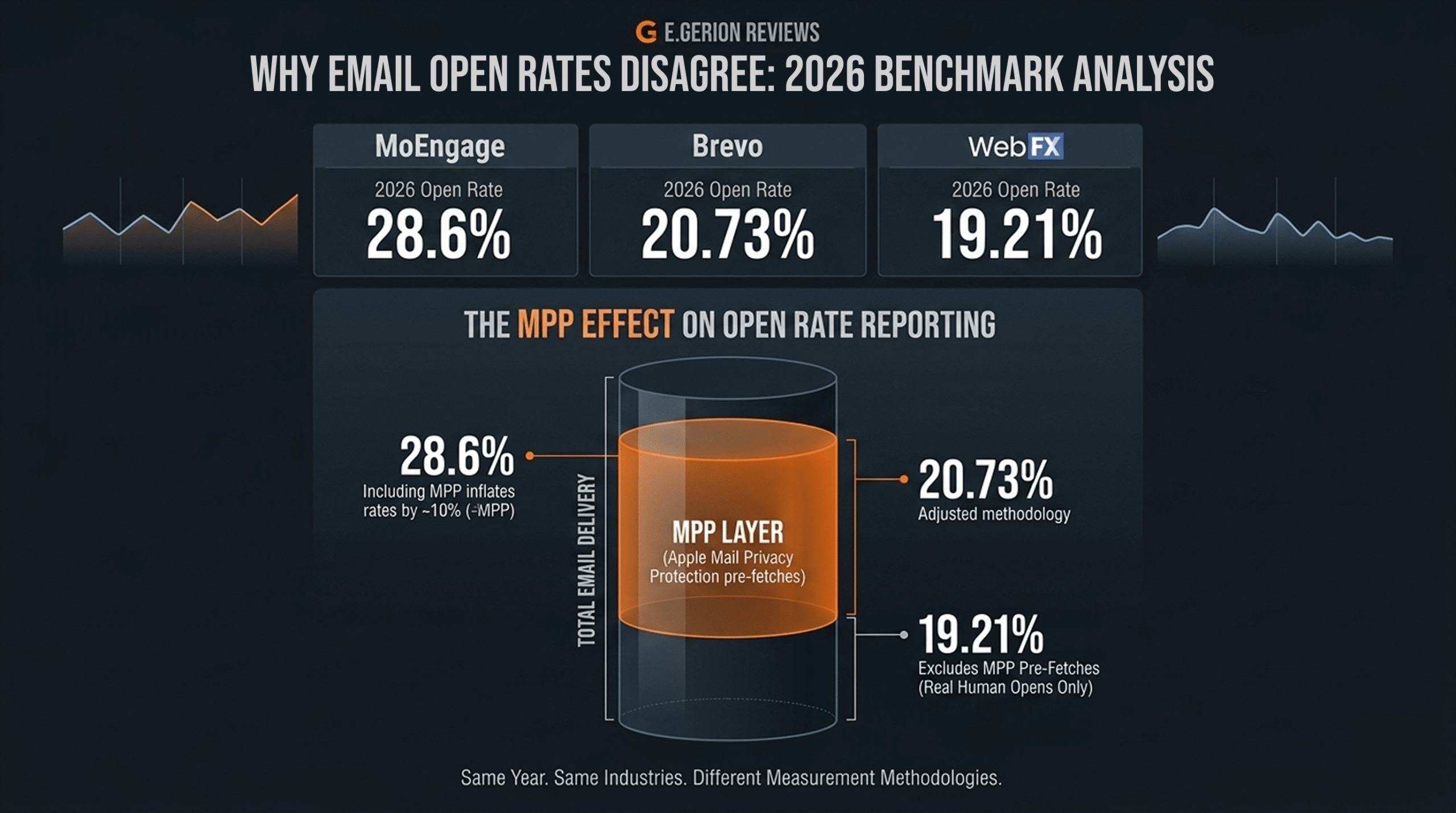
MoEngage puts average open rate at 28.6% with a range of 14.5% to 42.4% depending on segmentation quality. Brevo’s benchmark sits at 20.73% for standard open rate and 33.87% including Apple MPP inflation. WebFX reports 19.21% across all industries. Klaviyo’s automated flow click rate averages 5.58%, with top 10% of performers hitting 10.48%. Brevo’s automation CTR is 7.39% versus 2.27% for standard campaigns.
Analyst’s Take: Three sources, three different open rates for the same year. This isn’t measurement error — it’s a methodological divergence created by Apple’s Mail Privacy Protection, which pre-fetches tracking pixels on Apple devices regardless of whether a human actually opened the email. Every platform that includes MPP events in their open rate calculation shows numbers 10 to 15 percentage points higher than platforms that exclude them. Neither number is wrong; they’re measuring different things.
The practical consequence: if your benchmark comparison isn’t controlling for MPP methodology, you’re comparing apples to server logs. The metric that doesn’t lie is CTOR — click-to-open rate — because it divides real clicks by reported opens, and the MPP inflation affects both sides of the calculation proportionally. A CTOR between 10% and 20% represents genuine engagement. Below 10% means your content isn’t converting the people who did open. Below 5% is a content and relevance problem that no subject line optimization will solve.
The Klaviyo flow data is the number worth orienting around strategically: 41% of email revenue from 5.3% of send volume. That ratio tells you exactly where the ROI is concentrated. Automated behavioral flows are not a nice-to-have feature. They are where email makes money.
2 Article Topics for Your Next Publish
Topic 1: “The Salesforce Mandate: A Technical Guide to Domain Verification Before the June 29 Deadline”
This is the most time-sensitive topic in the market right now. A step-by-step technical walkthrough of DKIM key generation, domain verification inside Salesforce, and the DMARC escalation path from p=none to p=reject without breaking transactional flows. The audience is the technical-adjacent marketer who manages the platform but doesn’t have a dedicated deliverability engineer. Zero competition for this exact angle in the next seven days.
Topic 2: “Stop the Spray-and-Pray: How to Migrate from Broadcast Newsletters to Behavioral Lifecycle Flows in 90 Days”
The strategic counterpart to the technical piece. A structured migration roadmap for teams still running calendar-based blast campaigns: audit existing flows, identify the three highest-ROI behavioral triggers for your model, build the infrastructure, suppress the broadcast list until engagement data supports it. Uses the Klaviyo 41%/5.3% ratio as the economic argument and the Omnisend $3.41 vs $0.155 per-email data as the operational proof.

Final Word
The inbox in June 2026 rewards exactly one thing: relevance delivered at the right moment to the right person through infrastructure that’s technically sound enough to get there.
Everything else — the beautiful templates, the clever subject lines, the AI-generated personalization that fakes a relationship — is noise that inbox providers are increasingly effective at filtering before a human makes any decision about it.
The marketers who win from here are the ones who accept that email has become an engineering discipline as much as a creative one. Authentication is not optional. Behavioral triggers are not advanced features. List hygiene is not a quarterly project. These are the baseline operating conditions for inbox access in 2026.
Your subscribers are busy. Their inbox providers are protective. The bar to earn and keep a place in the primary tab has never been higher — and it will not come down.
Build accordingly.
Sources
- WordPress 7.0 / Gutenberg 23.3 Release Notes — wordpress.org
- MailPoet WordPress.org Support Forum, active threads June 22, 2026 — wordpress.org/support/plugin/mailpoet/
- Salesforce: Domain Verification Deadline June 29, 2026 — help.salesforce.com
- Digital Applied: Email Deliverability 2026 — The Inbox-Placement Playbook — digitalapplied.com
- EasyDMARC: Email Deliverability Issues 2026, June 18, 2026 — easydmarc.com/blog/email-deliverability-issues-in-2026/
- MarTech: DMARC new parameters June 2026 — martech.org
- HubSpot Breeze AI Suite — hubspot.com/products/artificial-intelligence
- Simular: Best AI Email Marketing Tools 2026 — simular.ai/alternatives/ai-email-marketing
- EmailTooltester: Spam Statistics 2026, updated June 18, 2026 — emailtooltester.com/en/blog/spam-statistics/
- Mailjet: Email Marketing Trends 2026 — mailjet.com/blog/email-best-practices/email-marketing-trends-2026/
- MoEngage: Average Email Open Rate 2026 — moengage.com/blog/average-email-open-rate/
- Brevo 2026 Marketing Orchestration Benchmark — brevo.com/blog/email-marketing-benchmarks/
- WebFX 2026 Email Benchmarks — webfx.com/blog/marketing/email-marketing-benchmarks/
- Klaviyo 2026 Omnichannel Benchmark Report — klaviyo.com/uk/blog/email-marketing-benchmarks-open-click-and-conversion-rates
- Omnisend Email Marketing Benchmarks, May 12, 2026 — omnisend.com/blog/email-marketing-benchmarks/