

When comparing HubSpot vs GetResponse vs ActiveCampaign in 2026, most reviews focus on features. I wanted to test something different — how each platform performs with real webinar flows under today’s AI inbox conditions.
A few weeks ago I was on a call with an e-commerce client. Their webinar had pulled 180 registrants — one of their best numbers this year. The presentation was solid, the chat was alive, people were engaged. Then the follow-up sequence hit a wall.
Most of the “thank you + special offer” emails never reached human eyes. Apple Intelligence and Gmail’s AI summaries quietly filed them into digest mode before any real person had a chance to act. The client lost an estimated $14,000 in missed sales — not because the tools failed technically, but because the bridge between webinar and CRM wasn’t built for 2026 conditions.
That’s what pushed me to re-test all three platforms head-to-head with real webinar flows. Not theoretical features. Actual behavior under today’s inbox rules.
Here’s what I found.
1. GetResponse: The Native Advantage
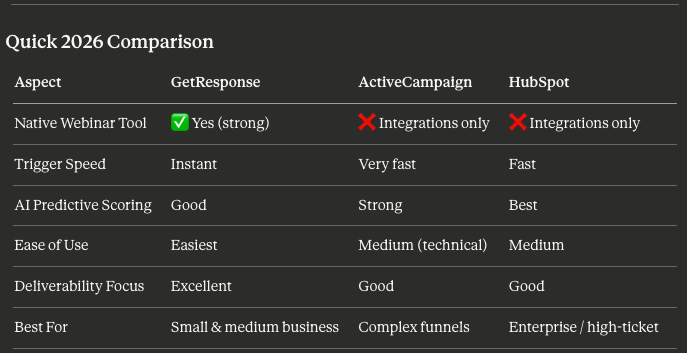
GetResponse is still the only platform in this group with a truly native webinar solution. In 2026, that distinction matters more than most people realize — and it comes down to one thing: data latency and deliverability risk.
I saw this play out clearly with a client last month. A user dropped off at the 11-minute mark. Because the webinar tool and email engine live inside the same ecosystem, the re-engagement email fired instantly — before the person even closed the browser tab. Conversion from that single automated email was over 18%.
That speed isn’t just impressive. It’s structurally harder for Apple Intelligence to misclassify as low-priority noise, because the signal is clean and contextually tight.
The Good: Native integration means fewer third-party tracking pixels, which means fewer reasons for Gmail and Apple Mail to flag your follow-up as suspicious. In 2026, every extra “bridge” you add between tools is a potential trust gap with the inbox.
The Catch: It’s an excellent all-rounder, but it doesn’t have the deep enterprise-level predictive intelligence of HubSpot. If you’re running complex, multi-product SaaS with a long sales cycle, you’ll eventually feel that ceiling.
2. HubSpot: The Enterprise Brain
HubSpot doesn’t own a webinar tool — it integrates with Zoom, WebinarJam, and others. That’s a real tradeoff. But its AI Assistant and predictive scoring are genuinely on another level.
In one test I ran for a SaaS client, HubSpot correctly identified which webinar attendees were 4x more likely to book a demo — based on their behavior over the previous 18 months. That kind of contextual intelligence is hard to match when your average deal size is high and every qualified lead counts.
The Good: Best-in-class CRM depth and AI-powered lead scoring. If your sales team needs to prioritize follow-up calls after a webinar, HubSpot tells them who to call first and why.
The Issue: You pay for it — in both money and complexity. Every additional integration adds a new layer of risk as mailbox providers get stricter about third-party tracking pixels. Managing those “bridges” in 2026 is not a set-it-and-forget-it situation.
3. ActiveCampaign: The Automation Specialist
ActiveCampaign shines when you need granular, conditional logic that most platforms can’t handle.
One of my clients used it to send completely different follow-up sequences depending on which poll answers attendees gave during the live session. Someone who answered “I’m ready to buy” got a direct offer sequence. Someone who answered “still researching” got a nurture track. The system handled it automatically, without any manual sorting.
The Good: The most powerful automation builder in this group. If you can think it, you can probably build it.
The Issue: It requires real technical confidence. If your team isn’t comfortable with advanced logic and flow architecture, ActiveCampaign can feel like sitting in an airplane cockpit when you only know how to use the radio. The tool rewards expertise and punishes shortcuts.
Final Verdict for 2026: Which One Fits Your Business?
There’s no universal winner here. The right platform depends entirely on your setup. Ultimately, deciding between HubSpot vs GetResponse vs ActiveCampaign comes down to how heavily you rely on automated webinar flows.
Choose GetResponse if you’re running a small or medium business, want your webinar and email tools under one roof, and don’t have a dedicated technical person managing your stack. Native integration means fewer moving parts — and fewer moving parts means fewer places for your follow-up sequence to break in 2026.
Choose ActiveCampaign when you have genuinely complex customer journeys and someone on the team who’s comfortable building detailed conditional logic. The power is real, but it rewards expertise. Don’t pay for the complexity if you’re not going to use it.
Choose HubSpot if you’re running high-ticket offers, have a sales team that needs predictive lead intelligence, and can justify the cost. For a business where one converted webinar attendee is worth thousands of dollars, the AI scoring pays for itself quickly. For everyone else, it’s likely more tool than the problem requires.
HubSpot vs GetResponse vs ActiveCampaign: The Real Question in 2026
It’s not about who has more features anymore. It’s about intercept rate — how many of your webinar attendees actually see your follow-up messages after AI summaries and inbox filters do their job.
The platform that gives you the cleanest, fastest, most reliable bridge from webinar registration to inbox wins. Everything else is a secondary consideration.
📚 References & Sources
- GetResponse Webinar Features — Official documentation on native webinar and email integration
- HubSpot Marketing Hub — AI assistant and predictive scoring capabilities
- ActiveCampaign Automation — Behavioral trigger and flow builder documentation
- Apple Intelligence: Mail Features — Official documentation on AI-driven inbox summarization
- Google Workspace: Gemini in Gmail — AI summary behavior in Gmail