

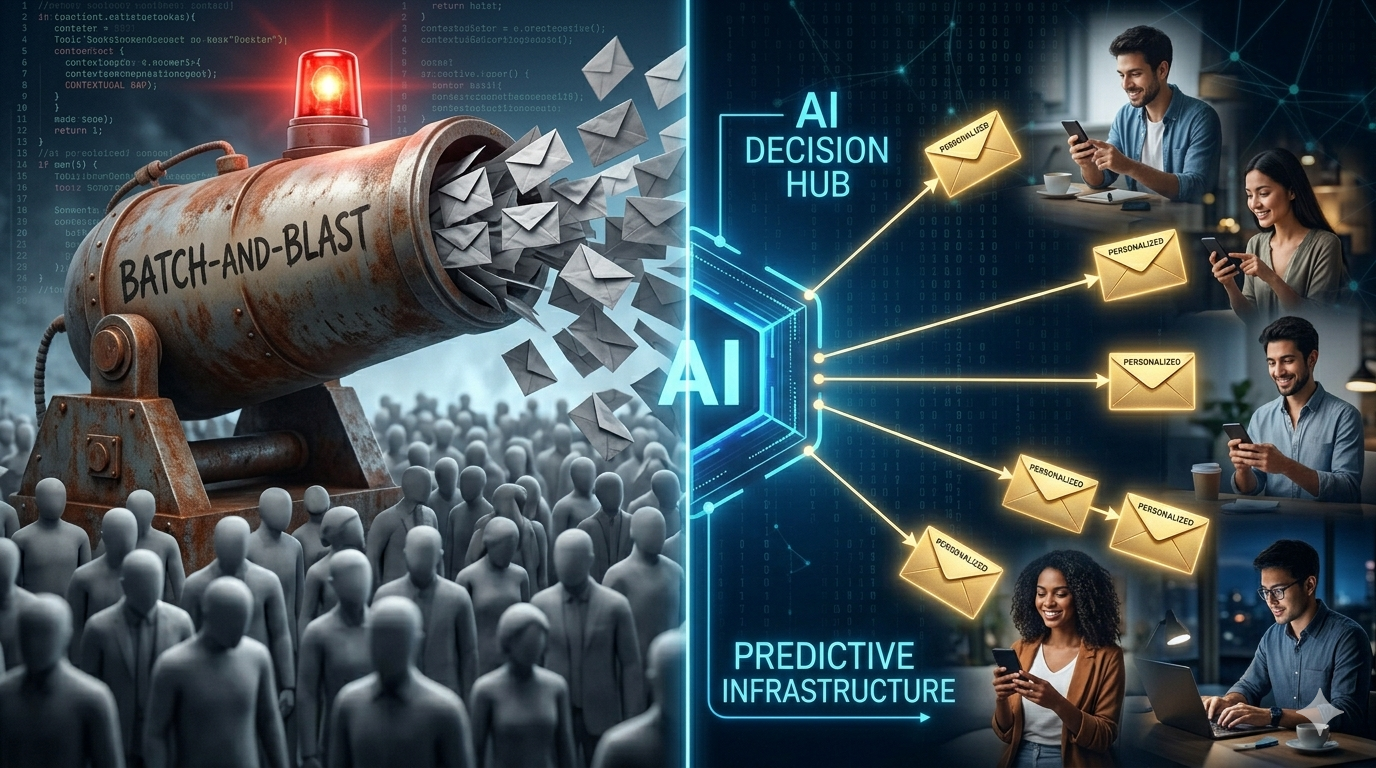
If you are still sending the same email to your entire list three times a week, stop calling it strategy. It is not strategy. It is a bulk-mailing habit dressed up as marketing.
Every time I see a brand hit ‘Send to All’ on a Tuesday morning just because it’s a habit, I don’t see marketing. I see a slow, expensive suicide of their domain reputation. In 2026, the inbox doesn’t forgive laziness—it simply stops showing your face to the world.
In 2026, predictive email marketing is not some shiny extra for overfunded teams. It is the baseline for anyone who expects inbox placement, engagement, and revenue. The market has already moved. AI now handles subject line optimization, send-time optimization, smarter segmentation, and real-time campaign monitoring. Meanwhile, too many brands are still running newsletters like it is a school craft lesson with a monthly KPI meeting attached.
The result is predictable: generic campaigns hit broad audiences at the wrong time, with the wrong message, under the delusion that “more sends” equals more outcomes. It does not. It equals more fatigue.
The 2026 Reality: Why Batch-and-Blast Is Broken
The old model was simple: build a list, write one message, hit send, and hope enough people click to justify the platform bill. That model is collapsing because inboxes in 2026 are no longer passive containers. They are filtered, ranked, summarized, and judged by AI systems that are ruthless toward repetitive, low-context communication.
This is exactly why predictive email marketing 2026 matters. Modern platforms are shifting away from static campaign calendars and toward decision engines that evaluate:
- When a subscriber is most likely to engage
- What content format they are most likely to respond to
- Which segment they actually belong to right now, not last quarter
- Whether a running campaign should be adjusted while it is still live
That is the technical break between old email marketing and the 2026 model. The campaign is no longer a fixed object. It is a monitored system.
And no, this does not mean AI replaces the marketer. It means AI replaces manual guesswork. The human still owns the brand voice, the offer, the positioning, and the quality control. Anyone handing all of that to machine-generated sludge deserves the spam folder they get.
Why It’s Broken: The Mechanical Failure of Mass Emailing
1. One message for everyone is a relevance failure
Mass sending assumes your list is one audience. It is not. It is a pile of different intents, buying stages, behaviors, and tolerance levels forced into one campaign because the team is too lazy or too underbuilt to segment properly.
In 2026, platforms are explicitly evolving toward AI segmentation and predictive decision-making because static grouping is too slow. A user who clicked a pricing page yesterday should not receive the same email as someone who has ignored you for six weeks.
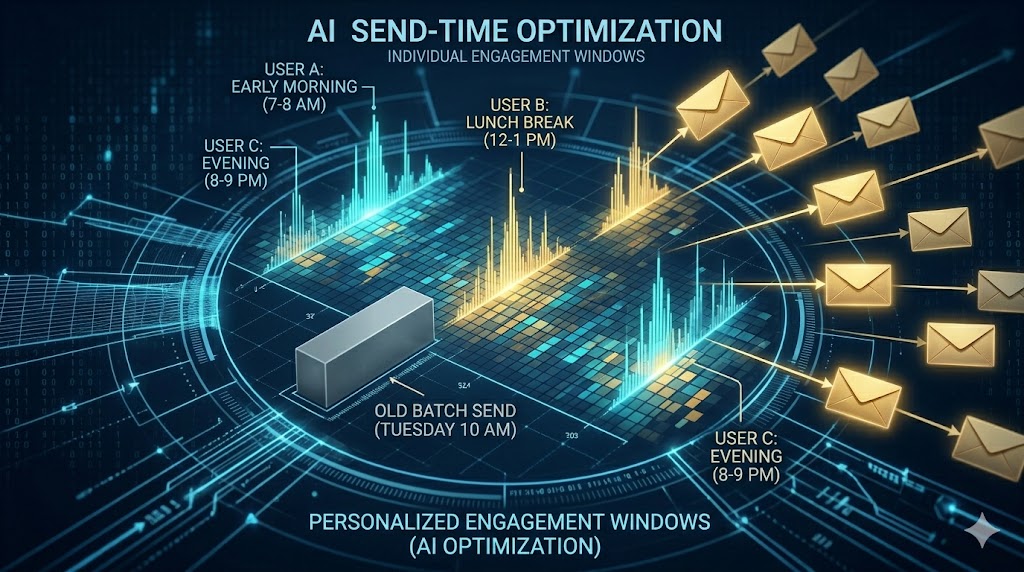
2. Scheduled blasts ignore engagement windows
The old “Tuesday at 10 AM” advice should be buried with every other piece of recycled email folklore. Send-time optimization exists because engagement is individual, not universal. If your system still treats timing like a fixed calendar slot, it is not optimized. It is asleep.
Modern AI email tools now push toward individualized send timing based on behavior and prior interaction patterns. That removes the guesswork and reduces the stupidity of sending the right email at the exact wrong moment.
3. Manual monitoring is too slow for live campaigns
One of the clearest 2026 shifts is real-time campaign monitoring and optimization. That matters because bad campaigns usually do not fail all at once. They decay in motion. Weak subject line performance, segment mismatch, stale pacing, and poor engagement signals compound while your team is still waiting for tomorrow’s dashboard.
AI now works behind the scenes to identify underperformance earlier. That does not mean it should write your brand voice for you. It means it should tell you when the machine is bleeding before the revenue report does.
The Real Shift: From Broadcast Calendar to Predictive Infrastructure
Most teams still think email marketing is about content production. In reality, in 2026 it is increasingly about decision infrastructure.
The winning stack is not the one with the prettiest template builder. It is the one that can do four things well:
- Predict audience behavior with usable accuracy
- Segment dynamically instead of statically
- Optimize send timing without manual scheduling obsession
- Monitor active campaigns and surface performance risks in real time
This is why businesses are moving toward ready-made email platforms with embedded AI. Not because marketers suddenly became obsessed with buzzwords, but because these systems now absorb operational friction that used to waste hours every week.
Subject line testing, send timing, behavioral grouping, and campaign oversight are no longer premium decorations. They are the mechanical core of efficient email operations.
The Anti-Trend Nobody Should Ignore: AI Content Without Human Control
Here is where weaker teams usually embarrass themselves.
They hear “AI email marketing” and assume the shortcut is to let the machine generate all the copy, all the campaigns, all the ideas, and all the messaging. That is not efficiency. That is outsourced mediocrity.
The 2026 direction is clear: AI is strongest behind the scenes. It improves segmentation, prediction, timing, and optimization. But brand communication still requires a human with standards.
Why? Because AI-generated content without supervision creates three problems immediately:
- Brand drift: the tone becomes generic and interchangeable
- Message decay: the copy becomes repetitive, padded, and obvious
- Trust erosion: subscribers can feel when they are reading automated filler
In other words, if your campaign sounds like it was assembled by a committee of autocomplete tools, the issue is not AI. The issue is that nobody serious reviewed it.
Use AI to sharpen decisions. Do not use it to flatten your brand into beige paste.
The Mechanical Breakdown: What Actually Changes in 2026
There is no verified weekly benchmark data in the source set for average open rate or CTR, so let’s not invent numbers like amateurs. What we do have is the more important signal: the industry is clearly reallocating effort away from batch sending and toward engagement optimization through AI.
That means the practical shift in 2026 looks like this:
- From list-wide campaigns to behavior-based segmentation
- From fixed send schedules to predictive send-time optimization
- From one-off reporting to live campaign monitoring
- From copy volume to message relevance
- From AI-written spam slurry to human-edited strategic communication
This is not cosmetic. It changes team workflows, reporting logic, and platform choice.
A founder or CMO should now be asking four blunt questions:
- Are we still emailing inactive people the same way we email active buyers?
- Are we choosing send times manually when the platform can optimize them?
- Are we monitoring campaigns while they run, or just autopsying them afterward?
- Are we using AI to improve decisions, or just to manufacture more forgettable copy?
If the answers are ugly, that is not a content issue. It is an operating model issue.
What Smart Teams Should Do Right Now
1. Kill the default list-wide newsletter habit
If every major update still goes to the whole database by default, your segmentation model is primitive. Build narrower logic based on behavior, recency, and intent.
2. Turn on AI where it actually matters
Use AI for:
- subject line optimization
- send-time optimization
- predictive segmentation
- campaign monitoring and adjustment
Do not confuse operational intelligence with creative replacement.
3. Keep humans in control of message quality
Your team should still own:
- brand tone
- offer structure
- editorial judgment
- quality control
If the machine drafts, a human edits. Every time.
4. Choose infrastructure, not just software
The real platform question in 2026 is not “Which tool has the nicest editor?” It is “Which tool gives us predictive control over relevance, timing, and campaign performance?”
Anything less is a newsletter toy.
The Verdict
Predictive email marketing 2026 is replacing batch-and-blast because the old model is structurally dumb. It sends the wrong message to the wrong person at the wrong time and then acts surprised when engagement rots.
Use AI to optimize decisions. Keep humans on copy and brand control. Stop flooding your list because your calendar says Tuesday.
Mass emailing is not dead because trends changed. It is dying because the mechanics are broken.
Fix the system.
Sources & Further Reading:
Litmus (2026): The State of Email Engagement: Why Predictive Models Replaced the Campaign Calendar
Google Workspace Updates: Advanced Neural Filtering and Engagement-Based Inbox Ranking in 2026
Forrester Research: The Death of Batch-and-Blast: How Predictive Analytics Drives 40% Higher ROI in B2B Communications
Email Experience Council (eec): Standardizing AI-Driven Send-Time Optimization (STO) for Global Infrastructure
Litmus (2026):
Google Workspace Updates:
Forrester Research:
Email Experience Council (eec):