

You’re paying for Mailchimp because it was the first thing you found when you Googled “email marketing.” That’s the honest explanation for why millions of e-commerce stores are using a tool built for general newsletters to run abandoned cart flows on Shopify stores doing $50K a month.
Klaviyo costs more. That’s also true. But the right question isn’t which platform is cheaper — it’s which platform generates more revenue per dollar spent. A 2026 cost-per-conversion analysis across 5,400 Shopify stores found that Klaviyo users generated an average of $72 in revenue per dollar spent on their email platform, compared to $38 per dollar for Mailchimp users — despite Mailchimp’s lower base subscription price. WebFX
That gap is what this article is actually about.
Section 1. Quick Verdict
Before the deep dive — here’s the bottom line in one table, so you can decide in 30 seconds whether to keep reading or go straight to the platform that fits your situation.
| Criteria | Klaviyo | Mailchimp |
|---|---|---|
| Best for | E-commerce / Shopify / WooCommerce | SMB, newsletters, non-e-commerce |
| Starting price | $20/mo (500 contacts) | $13/mo (500 contacts) |
| Free plan | 250 contacts, 500 sends | 250 contacts, 500 sends |
| E-commerce flows | 95+ pre-built, revenue-attributed | Basic, limited triggers |
| Segmentation | Predictive CLV, behavioral, real-time | Purchase history, basic filters |
| Revenue attribution | Native, per-email, per-flow | Limited, not native |
| Shopify integration | Native, deep, real-time | Works, but via workarounds |
| SMS | Integrated in flows | Add-on, separate from email |
| AI features | K:AI — predictive, flows AI | Intuit Assist (beta) |
| Deliverability | ~97% inbox placement | ~96% inbox placement |
| G2 rating (2026) | 4.6/5 (23,400+ reviews) | 4.4/5 (38,000+ reviews) |
| Winner | E-commerce revenue | Ease of use, non-e-comm |
Klaviyo wins automation, segmentation, revenue reporting, SMS, and e-commerce integrations — the categories that decide revenue for an online store. Mailchimp wins ease of use, templates, and pricing. If you run a Shopify store, the scorecard is not close. Venturz
Section 2. Pricing Reality Check
This is where most comparisons mislead you by showing only the headline numbers. Let’s look at what you actually pay — and what you actually get — at three list sizes.
What Klaviyo charges
Klaviyo’s Email plan runs approximately $20/month at 500 contacts, $30 at 1,000, $100 at 5,000, and $400 at 25,000. At 50,000 contacts, you’re looking at $720/month. The steepest jump is between 10,000 and 25,000 contacts — the price moves from $150 to $400, a 167% increase for a contact range that many growing Shopify stores hit within a strong year. The CMO Web Hosting Blog
One critical billing change from 2025 is still catching people off guard: Klaviyo shifted from billing based on profiles you actively emailed to billing based on total active profiles in your account, regardless of whether you’ve contacted them recently. A store with 20,000 total contacts but only emailing 8,000 of them pays at the 20,000 tier. The fix is routine list hygiene — suppress and delete cold contacts quarterly. Web Hosting Blog
What Mailchimp charges
Mailchimp’s Essentials plan starts at $13/month for 500 contacts. Standard, which adds multi-step automation, starts at $20/month for 500 contacts. At 5,000 contacts, those become $75 and $100 respectively. Premium starts at $350/month for 10,000 contacts. SQ Magazine
Here’s what the comparison charts don’t show you: Mailchimp charges for all contacts including unsubscribed ones, unless you permanently delete them. Subscribed, non-subscribed, and unsubscribed contacts count equally toward your billing tier. That’s a material difference. A list with 30% historical unsubscribes — completely normal for any mature e-commerce store — means you’re paying for contacts who will never receive another email from you. Expandi
In January 2026, Mailchimp cut its free plan from 500 contacts and 1,000 sends down to 250 contacts and 500 sends. In April 2026, prices increased 11–13% for legacy plan users. This is the second pricing change in 2026, and it’s not the last. Expandi
The real comparison at three tiers
| List size | Klaviyo Email | Mailchimp Standard | Winner on price |
|---|---|---|---|
| 1,000 contacts | $30/mo | ~$20/mo | Mailchimp |
| 5,000 contacts | $100/mo | $100/mo | Tie |
| 25,000 contacts | $400/mo | $270/mo | Mailchimp |
At 5,000 contacts, the price is identical. At 25,000 contacts, Mailchimp is cheaper. But at 5,000 contacts, Mailchimp Standard’s multi-step automation costs $100/month — the same as Klaviyo — but requires their Standard plan to unlock behavioral targeting and journey building. Without Standard, you’re on Essentials at $75 with basic automation only. SQ Magazine
The price comparison only tells half the story. The rest is what you build with the tool.
Section 3. Automation Depth: Where the Revenue Gap Actually Lives
This is the section that matters most for e-commerce operators, and it’s where the two platforms diverge most sharply.
What Mailchimp can do
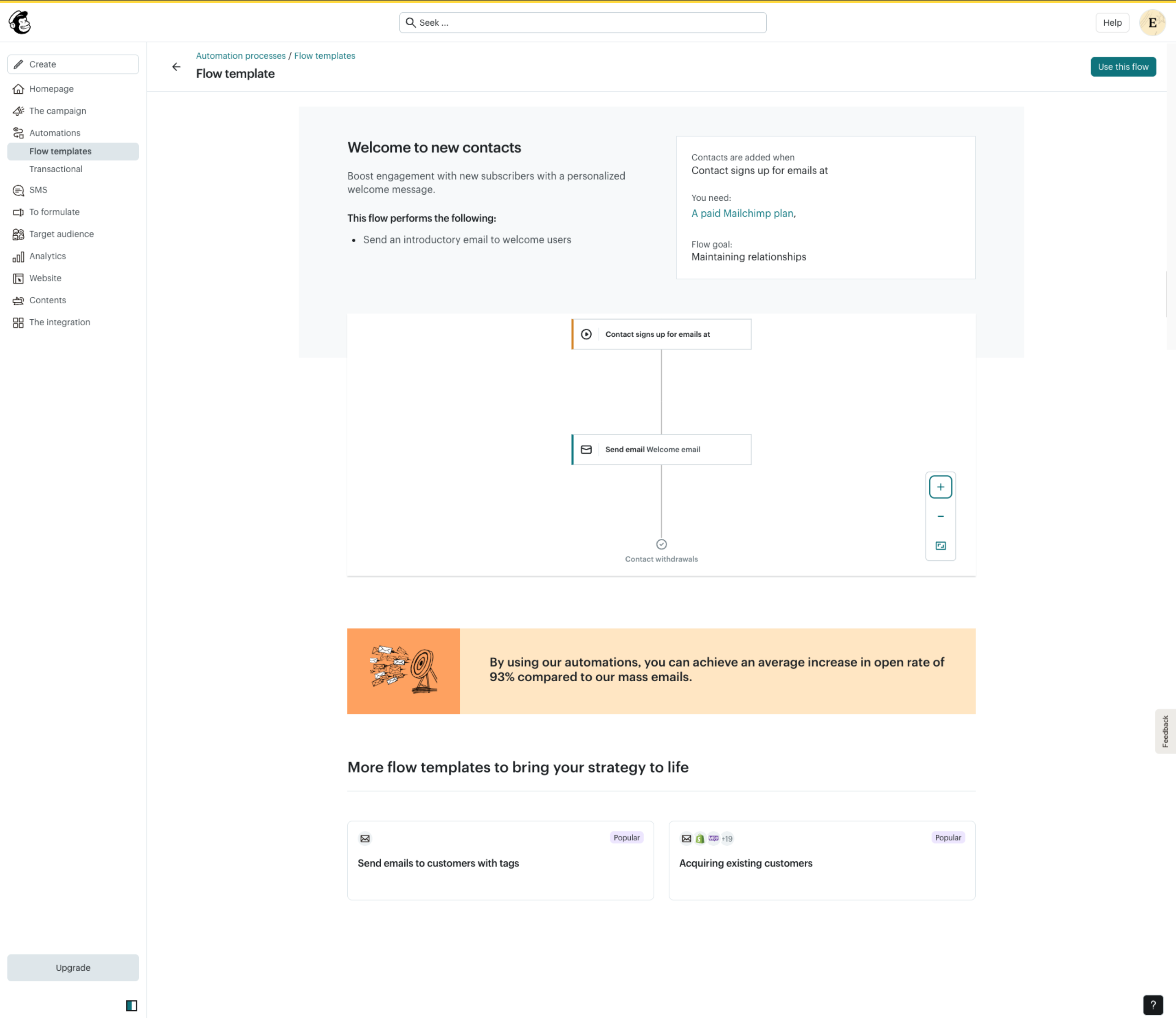
Mailchimp’s Customer Journey Builder is capable and genuinely improved over the last two years. Mailchimp’s Shopify integration works well for basic e-commerce automation — abandoned cart, post-purchase, and win-back sequences are all available. The limitation is data depth: Mailchimp shows you customer purchase history but not the granular behavioral data (product views, category browsing) that Klaviyo uses for advanced personalization. Dark Reading
In practice: Mailchimp can send an abandoned cart email. It cannot send an abandoned cart email that shows the specific product the customer viewed for 4 minutes last Tuesday, dynamically priced based on their predicted lifetime value, with a different discount threshold for VIP customers vs. first-time visitors.
What Klaviyo can do
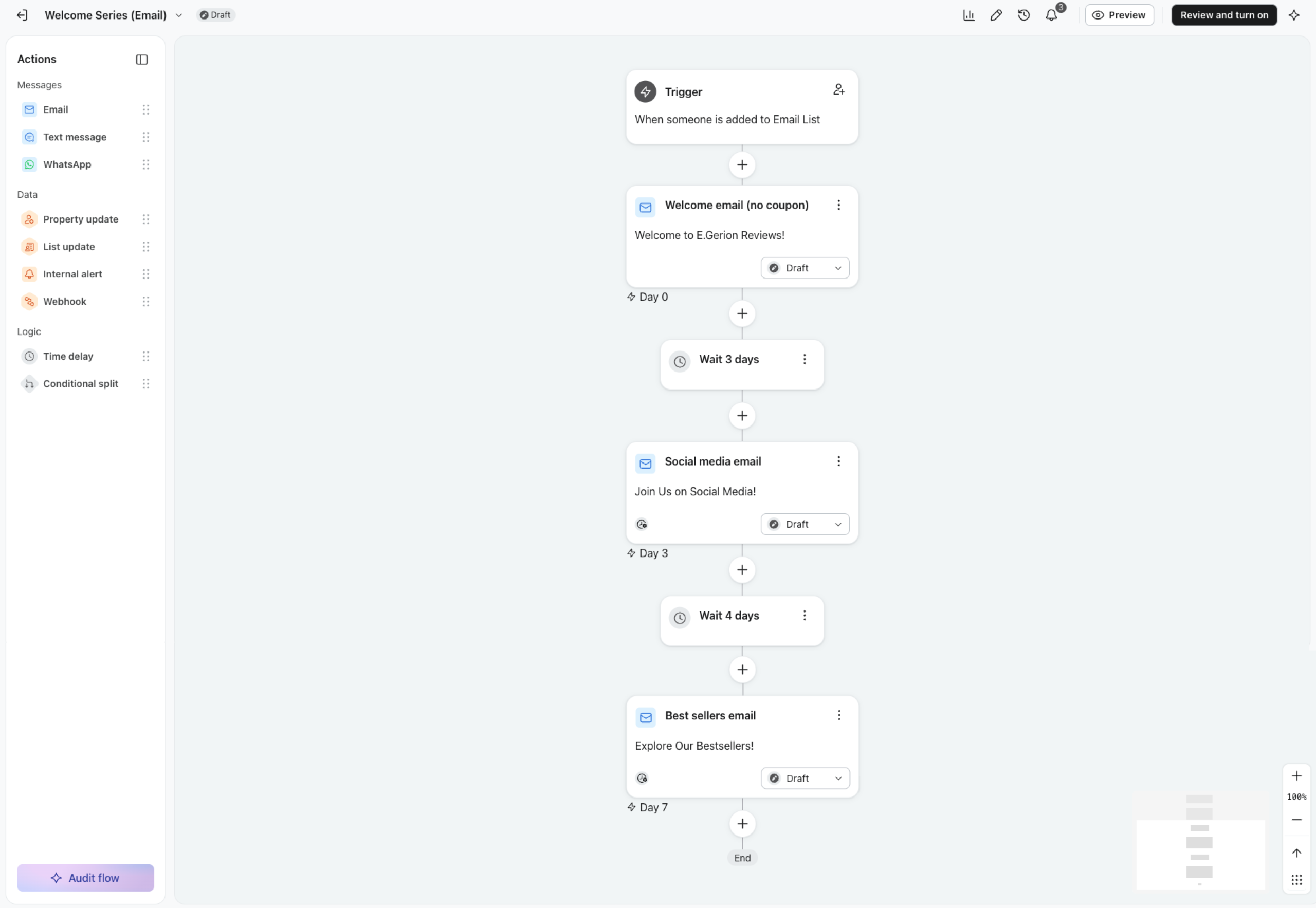
In 2026, Klaviyo expanded its pre-built flow library to 95+ e-commerce-specific automation templates, including AI-assisted post-purchase upsell sequences and loyalty milestone triggers, following a 58% increase in flow usage among its merchant base. WebFX
Klaviyo triggers emails based on highly specific customer actions: viewed a product, placed an order, added to cart, canceled a purchase, joined a segment, and much more. Flows include conditional logic, delays, splits, A/B testing, and multichannel elements like SMS and mobile push notifications — all within the same automation. Klaviyo
The revenue numbers from this architecture are not marginal: Klaviyo’s 2026 data shows automated flows average 42%+ open rates versus 31% for campaigns, 5.58% click rates versus 1.69%, and 2.11% placed order rates versus 0.16%. Prospeo
The abandoned cart benchmark that should settle the argument
Average abandoned cart recovery rate: 8.5% for Mailchimp users versus 14.2% for Klaviyo users, according to Omnisend’s 2025 e-commerce automation benchmark across 20,000 stores. Dark Reading
On a store doing 1,000 cart abandonments per month at a $50 average order value, that 5.7 percentage point difference is $2,850/month in recovered revenue — every month. Against Klaviyo’s $100–$150 monthly cost at that scale, the math is not a close call.
Section 4. Who Should Use What
Choose Mailchimp if:
You’re a small business, service provider, content creator, or nonprofit. You send newsletters, announcements, and basic campaigns. Your email list isn’t the primary revenue engine for a product business. You need something you can set up in an afternoon without a technical background. If your automation is a 3-email welcome series and an occasional broadcast, Mailchimp Standard is plenty. Klaviyo would be like buying a delivery van to commute to the office. ActiveCampaign
Also consider Mailchimp if you’re under $5K/month in store revenue and your list is under 1,000 contacts. At that size, Klaviyo’s learning curve costs more in time than the automation advantage generates in revenue.
Choose Klaviyo if:
You run a Shopify or WooCommerce store. You care about abandoned cart recovery, browse abandonment, post-purchase sequences, and predictive replenishment. You want to know exactly how much revenue each email and each flow generated — not just who opened it. Independent benchmarks consistently show Klaviyo-powered brands attributing 20–35% of total gross merchandise volume to email marketing, compared to the industry average of 15–20% for general-purpose ESPs. MailerLite
Multiple stores in the $30K–$200K monthly revenue range show a 15–30% revenue lift in the first quarter after moving from Mailchimp to Klaviyo, just by turning on default flows and adding 2–3 conditional splits. That’s not a marginal optimization. That’s a structural change in how the email channel performs. ActiveCampaign
The migration threshold: brands under $250K annual revenue with under 2,500 contacts often find Mailchimp provides sufficient automation capability at a lower cost. Above that, Klaviyo’s revenue advantage nearly always justifies the premium. Dark Reading
Section 5. The Honest Verdict
Mailchimp is not a bad tool. It’s a good tool being used for the wrong job by millions of e-commerce operators who chose it before they knew what they actually needed.
If you sell products online, your email platform needs to understand purchase behavior at a granular level, trigger responses in real time, and report revenue attribution with precision. Comparing Klaviyo to Mailchimp for e-commerce is a little like comparing apples to bananas, especially if you look at how other specialized plugins stack up in our MailPoet vs Klaviyo comparison. Klaviyo is a platform designed for e-commerce marketing. Mailchimp is a legacy email tool that added e-commerce features as an afterthought. Upland Adestra
The price difference is real. Klaviyo is more expensive at most list sizes. But the relevant question is never what the platform costs — it’s what it generates. At 5,000 contacts, both tools cost $100/month. Klaviyo’s abandoned cart recovery rate is 14.2% versus Mailchimp’s 8.5%. At any reasonable AOV, that difference pays for Klaviyo’s premium at scale before you close the pricing tab.
My recommendation is direct: if you’re running an e-commerce store doing more than $5K/month in revenue, you are leaving money in Mailchimp. Move to Klaviyo, build the three core flows — abandoned cart, browse abandonment, post-purchase — and measure the difference in 90 days. The data will make the decision for you.
If you’re not in e-commerce, Mailchimp is a solid, well-documented, widely-integrated tool that will handle your newsletter program competently for years. Stay there.
Try Klaviyo Free
Free up to 250 contacts. No credit card required. Full feature access.
Try Mailchimp Free
Free up to 250 contacts. 500 sends per month.
Sources
- Klaviyo Pricing 2026, verified June 2026 — klaviyo.com/pricing
- Klaviyo Pricing Breakdown (Spoks, May 18, 2026) — spoks.com/resources/klaviyo-pricing-breakdown
- Klaviyo True Cost at Every Tier (BuyerSprint, April 2026) — buyersprint.com/2026/04/11/klaviyo-pricing-2026/
- Mailchimp Pricing 2026, verified March 27, 2026 — mailchimp.com/pricing/marketing/
- Mailchimp Pricing Changes 2026 (Benchmark Email) — benchmarkemail.com/blog/mailchimp-pricing/
- Mailchimp Pricing Every Plan (Retainful, March 2026) — retainful.com/blog/mailchimp-pricing
- Klaviyo vs Mailchimp for E-Commerce 2026 (US Tech Automations, April 2026) — ustechautomations.com
- Klaviyo vs Mailchimp 2026 Comparison (Mailercloud, June 2026) — mailercloud.com/blog/klaviyo-vs-mailchimp
- Klaviyo vs Mailchimp 2026 (EmailToolScout, April 2026) — mailtoolscout.com/blog/klaviyo-vs-mailchimp
- Klaviyo vs Mailchimp Stats 2026 (Amra & Elma, March 2026) — amraandelma.com/klaviyo-vs-mailchimp-stats/
- Ecommerce Email Benchmarks 2026 (Threadpoint Agency, June 2026) — threadpoint.agency
- Mailchimp vs Klaviyo Full Comparison (Abhyashsuchi, March 2026) — abhyashsuchi.in/mailchimp-vs-klaviyo-2026-comparison/
- Klaviyo vs Mailchimp Honest Comparison (Moosend, February 2026) — moosend.com/blog/klaviyo-vs-mailchimp/
- Omnisend: Klaviyo Pricing 2026 — omnisend.com/blog/klaviyo-pricing/